Loading…
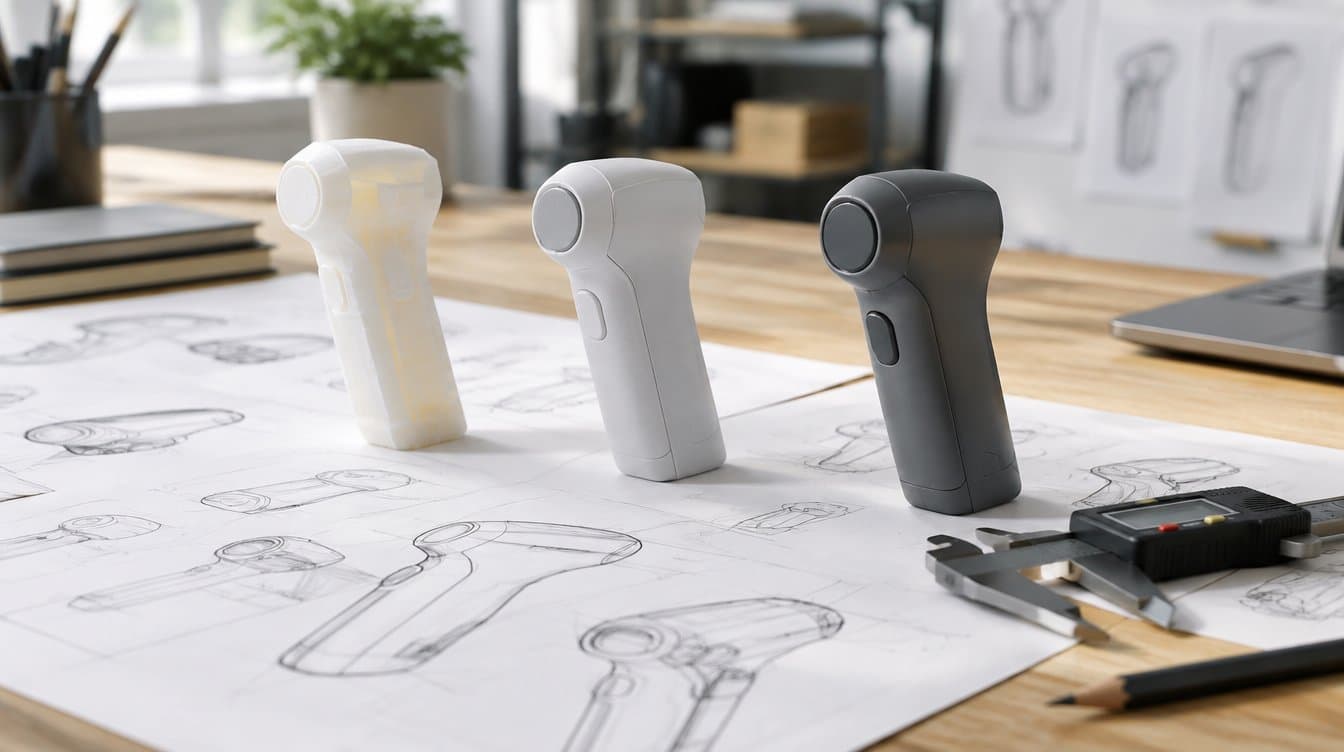
A patent describes an invention. A factory needs a product: exact geometry, materials, tolerances, finishes, and assembly steps, all chosen so the thing can be made at a cost the market will pay. Product development is the bridge — and it is where the economics of your entire business get decided. A design that costs $4.80 to make instead of $3.20 is not a 50-cent problem; compounded through retail margins, it is the difference between a viable product and a dead one.
This guide walks the development process stage by stage, with realistic costs, the failure points, and where professional help pays. It is part of our patent-to-product pillar guide.
Skip this stage and every later stage wobbles. Write down, in plain language:
One page is enough. It becomes the referee for every later trade-off.
Industrial design determines how the product looks, feels, and communicates — the difference between "works" and "people want it." Designers explore form through sketches and renderings, converging on a direction that fits your brand, your user, and your price point.
Cost: $2,000–$10,000 for a typical consumer product with an independent designer; more with agencies. What you should get: concept exploration, a refined direction, surface models, and CMF (color/material/finish) intent. Bring your requirements page and your patent drawings; good designers design inside the claims, not around them.
Mechanical engineering turns the design into a buildable definition: parametric CAD, wall thicknesses, fastening and assembly strategy, material selection, and tolerance decisions. This is also where design for manufacturing begins in earnest:
Cost: $5,000–$25,000 for typical consumer products. Deliverables to insist on: full CAD (you own the files), 2D drawings with critical dimensions and tolerances, and a bill of materials with candidate materials specified. These are the documents factories quote from — their quality determines whether quotes come back comparable.
Prototyping is a loop, not an event. Plan three generations minimum:
Test each generation with real users and write down what broke, confused, or disappointed. The Fly Cage — now a decade-long product — began as a crude backyard build whose early versions taught exactly what the manufactured design needed to be. That sequence, crude-to-refined-to-tooled, is the normal shape of success, not a detour from it.
Before tooling, put the design through a formal DFM review, ideally with input from the factory that will build it. The review hunts for cost and risk hiding in the geometry: undercuts that complicate molds, assemblies that need too many hands, cosmetic surfaces vulnerable to sink marks, materials specified tighter than the job requires.
A competent DFM pass routinely cuts unit cost 15–30% and prevents tooling rework that costs five figures and months. It is the single highest-return engineering money in the whole journey, which is why it is built into every ILG manufacturing engagement. Factories themselves will suggest DFM changes — welcome it, but have your own engineer in the conversation so cost cuts never quietly become quality cuts.
Identify your regulatory gates early and design for them, because retrofitting compliance is expensive:
Alongside compliance, run abuse testing on pre-production samples: drop, fatigue, environmental, and the specific torture your users will supply. Cost for typical consumer-product compliance testing: $1,000–$15,000 depending on category.
Development ends with a package your manufacturer can execute without interpretation: final CAD and drawings, bill of materials with approved alternates, assembly instructions, packaging dielines, the QC standard with defect classifications, and the golden sample. A complete handoff package is also your protection — it is what makes quality objective and supplier transitions possible if the relationship fails.
The recurring failure patterns: designing to the invention instead of the user; polishing prototypes forever instead of freezing a spec; skipping DFM and paying for it in tooling rework; specifying boutique materials a factory cannot source; and treating the factory's first sample as approved without formal review. All are avoidable with process — the stages above, taken in order, with the loops closed.
ILG takes products through this entire arc — design review, engineering, factory-integrated DFM, and into manufacturing — using the same process behind the 16+ products we have put on shelves. If you are holding a concept or patent and want it production-ready without learning every lesson at tooling prices, schedule a consultation.
For a typical consumer product: $2,000–$10,000 for industrial design, $5,000–$25,000 for mechanical engineering and CAD, and $1,000–$10,000 across prototype rounds. Simple single-material products land near the bottom of those ranges; products with electronics or moving assemblies go well past the top. Budget roughly $10,000–$40,000 to reach a production-ready design.
Concept and requirements, industrial design, engineering and CAD, prototyping (proof-of-concept, then looks-like/works-like, then pre-production samples), design for manufacturing refinement, testing and compliance, and production handoff. The stages overlap and loop — expect at least three design iterations before tooling.
Yes — several. Factories quote and tool from final CAD, but you should never cut steel on a design that hasn't been physically tested. A pre-production sample made by your actual manufacturer is the last gate: it becomes the golden sample every production unit is judged against.
Parts of it. Inventors with CAD skills can carry a design surprisingly far, and 3D printing makes early prototyping cheap. The stages that punish amateurs are design for manufacturing and tolerance engineering — mistakes there get baked into tooling at five-figure cost. At minimum, buy a professional DFM review before tooling.
For a typical consumer product, 4–9 months from concept to production-ready design: 1–2 months of design, 2–4 months of engineering and prototype loops, and 1–3 months of pre-production refinement with your factory. Electronics, certifications, or complex mechanisms extend every phase.
Talk through your situation with our team — no cost, no obligation.
Our team is happy to talk through your situation and explore your options.